A thorough exploration of the WhistlePig still, from chemistry to components. New information will be added weekly until the still is fully operational in October.
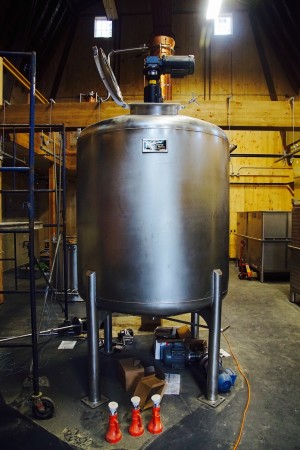 “Cooking the mash is like making custard. You have to heat it, and you have to cool it,” says Dave Pickerell, Master Distiller at WhistlePig Rye Whiskey. Cooking the grain turns the starch from a crystalline to a gelatin form, which you then cool before adding enzymes. Dave explains, “Imagine there was a massive ice storm which felled many trees, and someone piled up the branches. If you were asked to grab a single branch, they would all come at once. The first enzyme - alpha amylase - acts like pruning shears. Every time you find a crossed branch, you cut, and cut, and cut. All you’re left with is straight twigs.” There is still no sugar in the mixture, but at least the sticks are separated. This process is called liquefaction and happens in mere minutes. Dave shares, “It’s like the mixture transforms from oatmeal to juice in front of your very eyes.”
The second enzyme - glucoamylase or beta amylase - acts like taking sticks to a woodchipper. Put them in, and sawdust comes out the other side. The enzyme takes the broken starch and chomps off sugars one at a time. This process is called saccharification.
This entire process takes 6-8 hours. Lastly, once the mixture is cool enough, you add yeast.
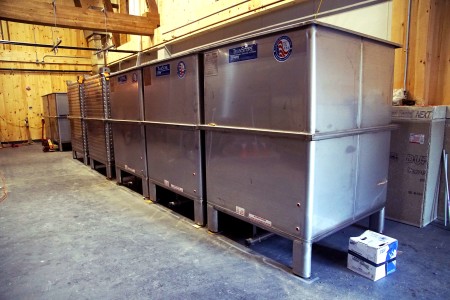 Open top steel tanks called fermenters house the next step in our distillation process. One cooked batch is pumped into one fermenter. The yeast has already been added, but the challenge is keeping the yeast happy and healthy, which is done by controlling the temperature. Dave explains, “Fermentation gives off heat, so if you let it go uncontrolled it will ruin the quality of the product or actually kill the yeast.” Healthy yeast eats and respires, giving off alcohol, CO2, and heat. To solve this temperature problem, cooling water is automatically fed into a jacket attached to the fermenter, in order to keep the fermentation at a prescribed temperature. When the entire process is done the liquid is 8-10% alcohol, which is then pumped into the still.
The fermenting process takes 5 days (or sometimes 4), during which time the yeast turns most of the sugar into alcohol.
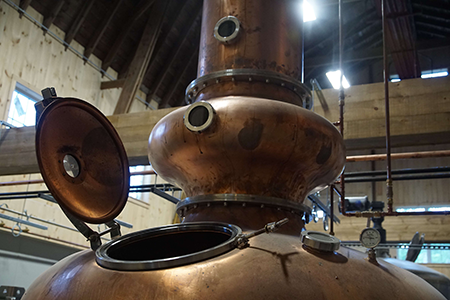 The iconic copper pot serves the simple purpose of holding the fermented liquid as it begins to be distilled. “The reason we use so much copper,” says Dave, “is because there are certain sulphur compounds in the grain, and sulphur can ruin the quality of your product.” Chemically, as sulphur heats and rises it forms a weak hydrogen bond with the copper. Therefore, the product coming out of the top of the still is devoid of sulphur, and a quick water rinse will send all the sulphur down the drain.
As an added note, malting tends to add a lot of sulphur, but this is a process more common in Scotland.
The reflux onion serves two purposes: 1) if the still gets foamy, the onion knocks the foam down before it moves up the column, and 2) it provides purity by adiabatic cooling.
Adiabatic cooling is the process of reducing heat through a change in air pressure caused by volume expansion. “In other words,” Pickerell explains, “imagine moisture laden air coming inland off the ocean. As it hits a mountain range it rises and expands. When it expands, the air cannot hold as much water, and therefore it rains.”
In the distillation process, moisture laden air goes to the narrow spot above the pot and rapidly expands within the onion. When it expands, the impurities with higher boiling points condense and fall back into the pot.
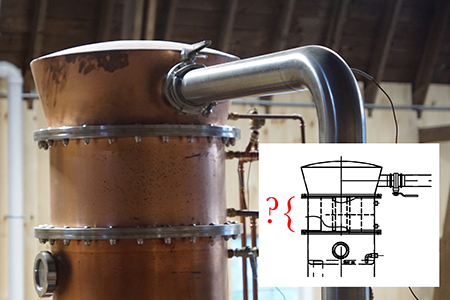 The column consists of two sections that are each four feet tall. Eight bubble cap trays are equally spaced along the length of the column, and each of these trays is roughly equivalent to the distillation power of one pot. They allow us to complete our distillation in one pass instead of several rounds through the system, so you have the rough equivalent of 9 distillations in one batch!
You can control the proof of the final alcohol by opening and closing the bubble cap trays individually. Proof increases with each distillation, so by opening a tray and leaving it ‘dry’ you are bringing the proof down.
Above the last bubble tray there is a small area which acts like a radiator in a car; this is the dephlegmator. We have the ability to circulate cold water through this area very precisely, which causes it to rain inside the still. This is a massive purification stage, because it has the effect of pushing all the higher boiling point items back into the copper pot.
The hat sits at the very top of the column and provides a little more adiabatic cooling. It functions like the onion, and lets vapor expand one more time before exiting the still.
 A small vapor pipe runs from the side of the column to the principal condenser. Rather than using a copper coil like many traditional stills, we pump cold water through a series of tubes inside the condenser. The alcoholic vapor condenses between the outer shell and the tubes themselves. A stainless steel pipe on the bottom of the principal condenser catches the liquid and sends it to the secondary condenser.
The function of the secondary condenser (aka product cooler) is to cool the product enough to test proof and store.
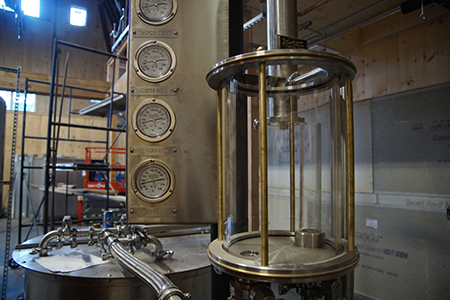
The spirit safe is a glass cylinder with a smaller glass cylinder inside. Liquid exiting the condensers flows into the small cylinder and overflows from the top. When running a batch, a hydrometer floats inside the smaller cylinder. Dave gets into the nitty-gritty when he explains, “This is calibrated in unison proof, so by examining how it’s floating we can determine the proof coming off the still.” An elegant distiller can look at the temperature gauges next to the still safe and control the system without even examining the proof. These gauges show how the still is performing and are directly related to the proof of the alcohol.
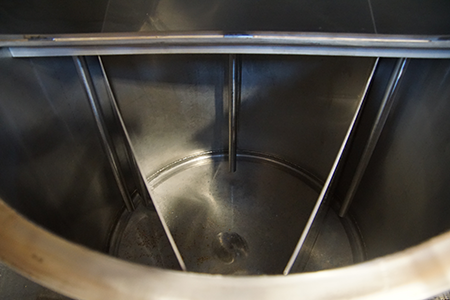 Made of stainless steel, the receiver has three compartments for heads, tails, and hearts. The heads and tails are are mostly alcohol and water, but with high concentrations of congeners and fusel oils that are unpleasant to drink. The hearts are prepared for aging and stored in wooden barrels in our rickhouse (this is the good, drinkable stuff we've come to know and love).