For America, it has been a long road back to rye.
Before the American Revolution, most Americans ate rye bread and drank Caribbean rum. Dutch settlers pushing up the Hudson brought the rye grain with them from the Low Countries, and introduced it to their Yankee neighbors, who needed a crop that could survive a winter far harsher than what they had left behind in England. Meanwhile, British ships regularly offloaded large volumes of rum shuttled from their West Indian colonies to their great colonial ports of Boston and New York. If Americans drank whiskey at all, it was because they were backwoodsmen too far from these ports to access this rum. These pioneer farmers turned to building their own stills, and distilling whatever might be left over from their harvests, as a way to keep the chill off in the cold northern winter.
Things changed in the cities, though, after the colonists entered open rebellion. The Crown responded by hitting Americans where it really hurt: by placing an embargo on rum imports. Thirsty and resourceful, the young republic turned to something it could produce independently: rye whiskey. If the American Revolution had an “Official Beverage”, it would’ve been rye. All the classic American whiskey drinks, like the Old Fashioned and the Manhattan, called for rye. The hearty grain was right at home in northeast American soil, toughing out the long winters and persevering throughout the seasons. George Washington himself became the largest producer and distributor of rye in the United States.
Pure, aged rye is more flavorful, complex, and delicious

than any corn-based whiskey.
Though sturdy and resilient in the ground, rye couldn’t stand up to the punishment of the Civil War. Along with the rest of the country, the rye industry was torn apart. As the decades passed, the punishment continued; prohibition and two world wars conspired to keep America’s finest whiskey buried in the frozen past. Even during periods of great prosperity, from the Roaring 20’s to the Baby Boom, the country poured all its capital-crop love into the sweetest, easiest grain of all: corn. Poor old rye was hung out to dry. With the lowest sugar content of all grains, it is the most difficult grain to distill. Rye is tacky, bratty, and stubborn… but the labor of love is worth the struggle. Pure, aged rye is more flavorful, complex, and delicious than any corn-based whiskey – just ask The Founding Fathers.
Speaking of fathers, WhistlePig was born in 2007, when Raj P. Bhakta bought the Farm. Rather, he purchased the farm. The point is, he is alive and well and married and a father, and the proud owner of WhistlePig Farm. After spending his last dime on 500-plus magical acres in Shoreham, VT, Raj joined forces with Master Distiller Dave Pickerell (of Maker’s Mark fame) to plot the long awaited return of rye whiskey to the States. The two men got their hands on the best batch of aged rye in North America. A few months later, in February ’09, they hatched a 5-year plan to transform WhistlePig Farm into the first ever single malt, one-stop rye shop, with all stages of the process located on site: from growing the grass, to distillation, to barreling and aging, to bottling. With the opening of our single-estate farm distillery in the summer of 2015, what was once a pig-headed dream will be a top-shelf reality.


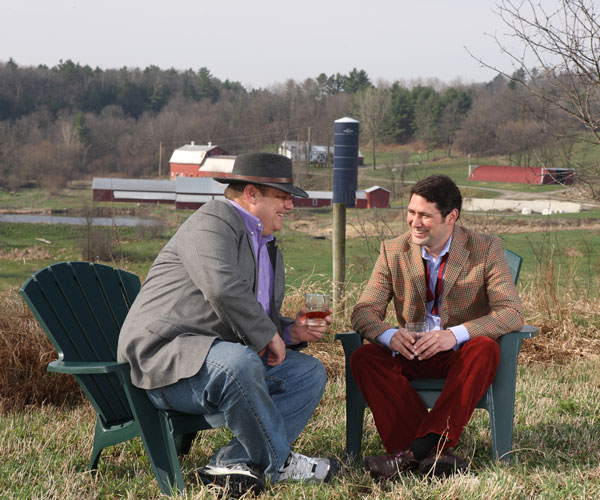
On January 1, 2010, Raj & Family cleared out an old barn, rolled up their flannel sleeves, and started bottling the exquisite rye. The ‘Pig was out of the pen! In 2013, the gang harvested its first crop of rye. And when distillation begins on the farm in autumn 2015, the WhistlePig vision will be complete. Just like that, after 200 years of lying dormant, Miss American Rye is back on her feet.
A Message from WhistlePig’s Founder to the People of Canada, and to Whiskey Drinkers Across the Globe


We at WhistlePig salute Canada’s accomplishments, past and present. Furthermore, as an American company, we pay homage to Canada as the producer of some of the world’s finest whiskey, if not the finest itself.
I offer this salutation for two reasons. First, I have just watched Argo (I am also told that Strange Brew is quite amusing). Second, I may have been guilty in the past, like many of my countrymen, of deriding Canada, as . . . well . . . just another, not particularly interesting, northern state, akin to North Dakota.
Speaking personally now, and for the record, I apologize. With respect to the Great White North, my views on Canada have been altered irrevocably.
For a time, my overwhelming enthusiasm for America, born of my background as the son of immigrants, coupled with my lack of interest in ice hockey and poutine, kept me from giving our northern neighbors their due. Now, however, with the benefit of age, maturity and experience, my unyielding and considerable admiration of Canada is informed by several considerations:
- I purchased a large stock of single grain Canadian rye whiskey distilled in the foothills of your Rocky Mountains; we finish the aging process here in Vermont, and bottle it as the highest rated rye whiskey in the world.
- I married a spectacular Canadian woman.
- My COO/CFO is a native of western Canada (he sports a wicked slapshot, and a propensity for ending his sentences with “Eh?”).
- My General Counsel was born and raised in an insignificant suburb of Windsor, Ontario known as Detroit; due to a geographic quirk, Detroit is one of the few places in the U.S. where one can gaze south into Canada.
- I read Churchill’s account of the Great World Wars of the last century. The British Bulldog observed that Canadians have fought in some of fiercest battles in history, with as much grit and bravery as any nation has ever exhibited in defense of liberty and freedom.
- Your national anthem lends itself better than the Star Spangled Banner to my natural baritone.
- You managed to keep your banks from imploding in 2008.
- Your banknotes are more cheerfully colored and have better pictures than our drab greenbacks.
- Montreal is the nearest major city to our farm in Shoreham, Vermont. The beauty of its people, and the richness of its history, is matched only by the quality of its food.
- The Mounties’ crimson is way cooler than any state trooper’s outfit.
Oh Canada, we too at WhistlePig, stand on guard for thee! Keep sending us your whiskey, and we will keep finishing it into the world’s finest rye, in addition to housing it alongside our future first single-estate American rye expressions.

With glowing hearts and glasses raised,
Raj Peter Bhakta